
How Do Slot Machines Work? A Player’s Guide to RNG, RTP, Paylines and Payouts
Slot machines look simple from the outside. You choose a bet, press spin, watch the reels move, and wait for the result. Easy enough.
If you already know how to press spin but want to understand what the reels are really doing, this guide is for you.
Behind that spin, there is a full system working in the background. Random number generators decide outcomes. Paytables define what those outcomes are worth. RTP shapes the long-term math. Volatility affects how bumpy the ride feels. Bonus features and jackpots can change where the biggest payouts sit.
So, how do slot machines work? In plain terms, they use random outcomes, fixed game rules, and payout math to decide every spin.
This guide explains those mechanics without dressing them up as a secret system. Slots are random games with a built-in house edge. You cannot predict the next spin, but you can understand what is happening behind the reels and use that knowledge to choose games that better fit your session.
How Slot Machines Work: The Quick Answer
Slot machines work by using a random number generator, or RNG, to produce a result for every spin. Once the result is selected, the game displays the matching reel outcome on screen.
If the symbols line up according to the game’s paytable, the slot pays out based on the rules, your bet size, and the value of that winning combination.
That is the short version: press spin, RNG selects result, reels show result, paytable calculates payout.
The glitter, sound effects, reel animations, and dramatic near-misses are part of the show. The actual outcome is decided by the slot’s underlying math.
What Happens After You Press Spin?

The moment you press spin, the slot’s RNG selects a result. This happens instantly. The reels may keep spinning for a few seconds, but that does not mean the machine is still deciding whether to pay.
The animation is there to show the result in a way that feels like a slot machine. It is not a physical process where symbols slowly land by chance as the reels stop.
Think of it like this:
| Step | What Happens |
|---|---|
| You press spin | The game receives your bet and starts the spin |
| RNG selects a result | A random outcome is chosen instantly |
| Reels display symbols | The game shows the visual version of that result |
| Paytable checks the outcome | Winning combinations are identified |
| Payout is calculated | Any win is paid based on the rules and your bet |
That is the spin process stripped down: RNG first, reel display second, payout check last.
New to terms such as reels, paylines, RTP, or volatility? Our plain-English slots terminology glossary explains the essential vocabulary used throughout this guide.
Why Slot Results Are Random, Not Predictable
Slot results are random because each spin is controlled by an RNG. The RNG does not care what happened on your last spin, how long you have played, how much you have bet, or whether the game has been quiet for the past 20 minutes.
Each spin is a separate event. A losing streak does not make a win more likely. A recent bonus round does not make the next bonus less likely. The game is not balancing your session in real time.
That is why slot machines cannot be predicted in the way some players hope. You can understand the game’s RTP, volatility, features, and payout structure, but you cannot know when a specific result is coming.
For a deeper breakdown, read our guide to how random number generators work in slots.
How the Paytable Turns a Result Into a Payout

The paytable is the rulebook for the slot. It tells you which symbols pay, how much they pay, which combinations count, how bonus features trigger, and whether any special rules apply.
For example, a slot might pay for:
- Three matching symbols from left to right
- Five matching symbols on a selected payline
- Scatter symbols landing anywhere on the reels
- Cluster groups of matching symbols
- Bonus symbols triggering a second-screen feature
Once the RNG produces a result, the game checks that result against the paytable. If the result matches a winning combination, the slot pays according to the listed value and your bet.
If you want to go deeper into the rules screen, our guide on how to read a slot paytable explains what to check before you spin.
How Do Online Slots Decide Who Wins?
Online slots decide who wins through RNG software. The RNG produces outcomes continuously, and the result connected to your spin is the one used by the game.
That means the machine is not choosing a winner in the human sense. It is not watching players, rewarding loyalty, punishing short sessions, or warming up for a jackpot. It is following programmed math and selecting random outcomes.
What Is a Random Number Generator in Slots?
A random number generator is the system that creates random outcomes for each slot spin.
In online slots, the RNG is software-based. It cycles through numbers at high speed, even when nobody is actively pressing spin. When you start a spin, the game takes a number from that stream and maps it to a result.
That result might be a losing spin, a small payout, a free spins trigger, a bonus feature, or a jackpot-eligible outcome depending on the game’s design.
The key point is simple: the RNG decides the outcome before the reels finish moving.
How RNGs Pick the Result of Each Spin
The RNG does not “pick symbols” the way a person might choose cards from a deck. It generates a number. The slot then uses its internal mapping to turn that number into a reel result.
In a simple version, the process looks like this:
- The player presses spin.
- The RNG produces or captures a number.
- That number maps to a set of reel positions.
- The reels display those positions.
- The paytable checks whether the result pays.
The player only sees the final stage: the reels landing on symbols. The math happens underneath.
Why Every Spin Is Independent
Every spin is independent because the RNG does not use previous results to decide future ones.
That is one of the biggest ideas to understand about slot machines. If a game has not paid for a while, that does not mean it is due. If it just paid a large bonus, that does not mean it needs to cool down. The next spin is its own event.
The same logic applies to bet size. A larger bet may increase the dollar value of a payout, and it may be required for certain jackpot features, but it does not make the RNG more likely to produce a winning result.
The machine is not building a story. It is producing independent outcomes.
Can a Slot Machine Be Due to Hit?
No. A slot machine is not due to hit just because it has gone through a dry spell.
This is one of the most common slot myths because the human brain loves patterns. If something has not happened in a while, it feels like it should happen soon. Slots do not work that way.
A game can go hundreds of spins without a major feature, then land one out of nowhere. Another game can trigger a bonus quickly and then go quiet. That rhythm is part of variance, not proof that the machine is preparing to pay.
For more on this, see our guide to hot vs cold slot machines.
Reels, Symbols and Winning Combinations Explained
Reels and symbols are the visual language of a slot machine. They show the outcome in a way players can quickly understand.
Older slot machines used physical reels. Modern online slots use digital reels, virtual reel mapping, animations, and more complex layouts. The idea is still familiar, but the math behind it has become much bigger.
-> Our guide to slot machine symbols explains the difference between regular icons, wilds, scatters and bonus symbols.
Physical Reels vs Virtual Reels
Physical reel slots use mechanical reels with a limited number of stops. Each stop has a symbol printed on it. When the reels spin and stop, the visible symbols create the result.
Online slots and modern video slots work differently. They use virtual reels. The reels you see on screen are visual representations of a digital outcome.
Virtual reel mapping means the game can assign many possible virtual stops behind the visible reels. That gives developers more control over how often symbols appear, how bonus triggers behave, and how payouts are distributed.
So when you see five reels and rows of symbols, you are seeing the display layer. The result itself comes from the slot’s underlying math.
How Slot Symbols Create Winning Results
Slot symbols create wins when they land in patterns listed in the paytable.
Common symbol types include:
| Symbol Type | What It Usually Does |
|---|---|
| Regular symbols | Form standard winning combinations |
| High-paying symbols | Pay more than lower-value symbols |
| Wilds | Substitute for other symbols in many combinations |
| Scatters | Often trigger free spins or bonuses |
| Bonus symbols | Open special features or second-screen games |
| Jackpot symbols | May contribute to jackpot triggers or prize levels |
Not every game uses symbols the same way. In one slot, scatters may trigger free spins. In another, they may award instant prizes. In another, special symbols might collect values, unlock multipliers, or move across reels.
The paytable is where those rules live.
Why Modern Slots Can Have Thousands of Possible Outcomes
Modern slots can have thousands of possible outcomes because they are not limited to three reels and one straight payline.
A game might have:
- Five or six reels
- Multiple rows
- Dozens of paylines
- Hundreds or thousands of payways
- Cascading wins
- Expanding reels
- Cluster pays
- Bonus modifiers
- Progressive jackpot triggers
That is why two slots can look similar but feel completely different. One might pay small amounts often. Another might save most of its value for a rare bonus round. Another might be built around a huge max win that only appears under specific conditions.
The visible layout gives you clues, but the real story is in the paytable and game info.
How Do Slot Machine Paylines Work?
Slot machine paylines are the patterns used to check winning combinations. In a traditional slot, a payline might run straight across the middle row. In modern slots, paylines can zigzag, move across several rows, or be replaced by payways and cluster systems.
Paylines matter because they define where symbols need to land for a regular win.
For a deeper guide, read more about how paylines and hit frequency work.
What Is a Payline in Slots?
A payline is a line across the reels where matching symbols can create a payout.
For example, a five-reel slot might pay when three or more matching symbols land from left to right on an active payline. If the symbols land outside that line, they may not count unless the game uses a different system.
A simple payline could look like this:
| Reel 1 | Reel 2 | Reel 3 | Reel 4 | Reel 5 |
|---|---|---|---|---|
| A | A | A | ||
In that example, three matching symbols land across the middle row. If that row is an active payline and the paytable lists three A symbols as a win, the game pays.
Paylines vs Payways: What’s the Difference?
Paylines use fixed patterns. Payways are more flexible.
In a payline slot, symbols need to land on specific lines. In a payways slot, symbols usually need to appear on adjacent reels, but they can land in different row positions.
For example, a 243 ways slot might count matching symbols across reels without requiring them to sit on one fixed line. Megaways slots take that further by changing the number of symbols on each reel from spin to spin, creating a changing number of possible ways to win.
Here is the clean version:
| System | How Wins Are Checked |
|---|---|
| Paylines | Symbols must land on fixed patterns |
| Payways | Symbols usually need to appear on adjacent reels, not fixed lines |
| Megaways | Reel height changes, creating a variable number of ways to win |
| Cluster pays | Groups of matching symbols pay when they connect |
If this is the part you want to unpack further, see our full comparison of payways vs paylines.
Cluster Pays and Other Modern Slot Layouts
Cluster pays slots do not use traditional left-to-right paylines. Instead, they pay when a set number of matching symbols connect in a cluster.
These games often use grid layouts instead of standard reel rows. They may also include cascading wins, where winning symbols disappear and new ones drop into place. That can create chain reactions within the same spin.
Other modern layouts may include expanding reels, symbol collections, hold-and-win features, or special meters. The more unusual the layout, the more important the paytable becomes.
Why More Paylines Do Not Guarantee More Wins
More paylines can create more possible ways to form winning combinations, but they do not guarantee profit or better results.
The game’s RTP, volatility, symbol values, bonus frequency, and paytable still control the overall math. A slot with many paylines can still be highly volatile. A slot with fewer paylines can still pay frequently.
More lines usually mean more coverage per spin, but your total bet may also increase depending on the game. That is why it is worth checking whether the bet is per line, per spin, or structured another way.
How Do Slot Machines Pay Out?

Slot machines pay out when the spin result matches a winning combination in the paytable. The amount depends on the symbols, the number of matching symbols, the game rules, and your bet size.
A slot does not pay just because symbols look close. It pays when the result meets the exact conditions listed in the rules.
How Winning Combinations Are Calculated
Winning combinations are calculated by comparing the final reel result against the paytable.
A basic slot might pay for three, four, or five matching symbols on a payline. A payways slot might pay when matching symbols appear on consecutive reels. A cluster pays slot might pay when a certain number of matching symbols touch.
Example:
| Result | Paytable Rule | Outcome |
|---|---|---|
| Three cherries on a payline | Pays 5x total bet | Win |
| Four cherries on a payline | Pays 20x total bet | Bigger win |
| Three scatters anywhere | Triggers free spins | Bonus feature |
| Two bonus symbols only | No listed payout | No bonus |
The exact numbers change by game. The logic stays the same: paytable first, payout second.
How Bet Size Affects Slot Payouts
Bet size affects how much a winning result pays in dollars.
If a slot pays 50x your bet and you bet $0.40, the payout is $20. If you bet $2 on the same 50x result, the payout is $100.
Same multiplier. Different dollar value.
| Bet Size | Win Multiplier | Payout |
|---|---|---|
| $0.40 | 50x | $20 |
| $1.00 | 50x | $50 |
| $2.00 | 50x | $100 |
Bet size does not make a random result easier to predict. It changes the value of the outcome when a win lands.
Some games also connect certain prizes or jackpots to bet level. If a jackpot requires max bet, the paytable should say so.
What Max Win Means in Online Slots
Max win is the highest possible payout the slot can award, usually shown as a multiplier of your bet.
A 5,000x max win means the game can theoretically pay up to 5,000 times your stake. If your bet is $1, that ceiling would be $5,000. If your bet is $0.20, that ceiling would be $1,000.
Max win is useful, but it can be misleading when viewed alone. A game with a massive max win may also be highly volatile, which means the biggest outcomes are rare and the session can include long stretches without meaningful wins.
Bigger ceiling, bigger swings. That trade-off is part of the design.
Why Bigger Prizes Usually Come With Bigger Swings
Bigger prize potential usually means more variance. The game has to balance its payout structure somewhere.
If a slot offers frequent small wins, simple features, and a steady rhythm, it usually has less room for enormous top-end payouts. If a slot advertises huge multipliers, progressive jackpots, or feature chains, more of the game’s value may sit in rare outcomes.
That is why some slots feel smooth and others feel like they are waiting for one dramatic moment. Both can have similar RTPs, but they distribute wins differently.
What Is RTP in Slot Machines?

RTP stands for Return to Player. It is the theoretical payout percentage a slot is designed to return to players over a very large number of spins.
RTP is one of the most useful slot terms to understand, but it is also one of the easiest to overread. For a deeper explanation, see our guide to what RTP means in slots.
RTP Meaning: Return to Player Explained
A slot with 96% RTP is designed to return $96 for every $100 wagered over the long run. That does not mean you personally will get $96 back after betting $100.
RTP is based on huge samples of play, not one session, one night, or one player.
Most online slots sit somewhere around the mid-90% RTP range, though exact numbers vary by game, version, casino, and jurisdiction. Always check the game info screen or paytable for the number that applies to the version you are playing.
RTP vs Short-Term Results
RTP does not predict short-term results.
You can play a 96% RTP slot and lose quickly. You can play a lower RTP game and hit a strong bonus early. Both can happen because each session is a tiny slice of the game’s long-term math.
RTP tells you how the game is designed over time. It does not tell you what your next 20 spins will do.
That is why RTP should be read alongside volatility, hit frequency, features, and bet size.
RTP vs House Edge
RTP and house edge are two sides of the same coin.
If a slot has 96% RTP, the house edge is 4%. If a slot has 95% RTP, the house edge is 5%.
| RTP | House Edge |
| 97% | 3% |
| 96% | 4% |
| 95% | 5% |
| 94% | 6% |
House edge is the long-term mathematical advantage built into the game. It does not mean the casino wins every spin. It means the game is designed so the math favors the house over a large enough sample.
Example: What a 96% RTP Slot Really Means
Imagine a 96% RTP slot with $1,000,000 wagered across a huge number of spins by many players.
The game is theoretically designed to return around $960,000 in payouts and keep around $40,000 as house edge.
That does not happen in a neat straight line. One player might hit a huge feature. Another might have a rough session. The game’s long-term average only becomes meaningful across massive volume.
That is RTP in plain English: useful for comparing games, useless for predicting your next spin.
Volatility and Variance in Slot Machines
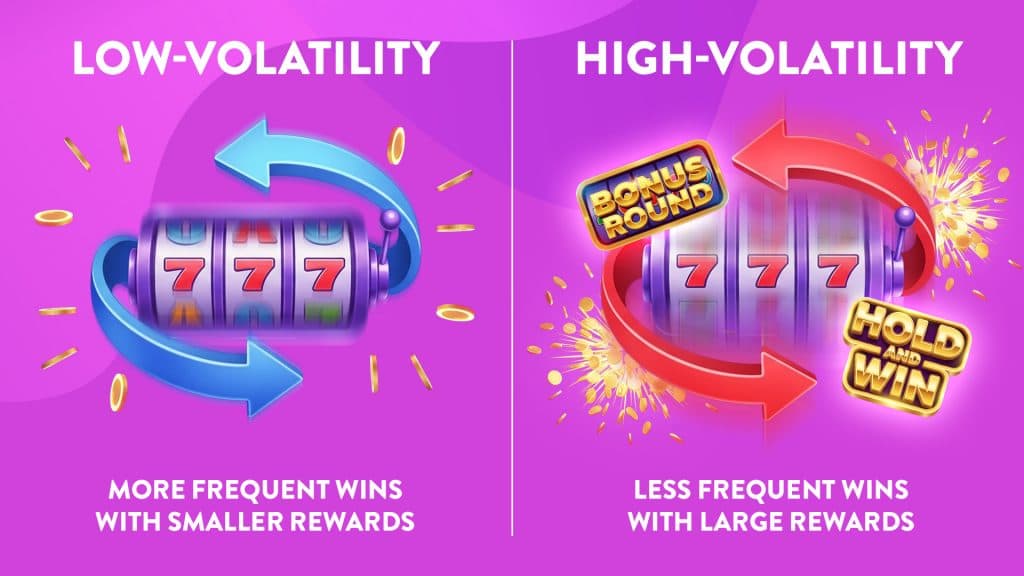
Volatility describes how a slot tends to distribute wins. Variance is closely related and is often used to describe how much results can swing around the average.
In player terms, volatility tells you what kind of ride you are signing up for.
For a full breakdown, read our guide to slot volatility explained.
What Is Slot Volatility?
Slot volatility is the level of risk and payout swing built into a slot game.
Low-volatility slots tend to pay smaller wins more often. High-volatility slots tend to pay less often, but they can produce bigger wins when the right result lands.
Volatility does not tell you whether a slot is “better.” It tells you how the game feels.
Low Volatility Slots: Smaller Wins More Often
Low-volatility slots are built for steadier sessions. They usually deliver more frequent small wins, which can help a bankroll last longer.
That does not mean they are safe or guaranteed to pay. They are still random games. The difference is in the distribution. You are more likely to see regular movement instead of waiting around for one monster feature.
Low volatility can make sense when the goal is a longer session on a fixed budget.
High Volatility Slots: Bigger Wins Less Often
High-volatility slots are built for bigger swings. They may place more value in free spins, multipliers, jackpots, or rare bonus rounds.
These games can be exciting because the top-end potential is higher. They can also drain a bankroll faster when the features do not land.
A high-volatility slot is not “hotter.” It is just built differently. The math is more top-heavy.
For a direct comparison, see our guide to high vs low volatility slots.
How Hit Frequency Fits Into the Picture
Hit frequency is how often a slot produces any winning result.
A slot with high hit frequency may pay often, but the wins can be small. A slot with lower hit frequency may go longer between payouts, but the wins may be more meaningful when they land.
Hit frequency is not the same as RTP. A game can have frequent tiny wins and still have a lower RTP than another game with fewer but larger payouts.
Read RTP, volatility, and hit frequency together. That trio gives a much clearer picture than any one number on its own.
How Bonus Features Work in Slots
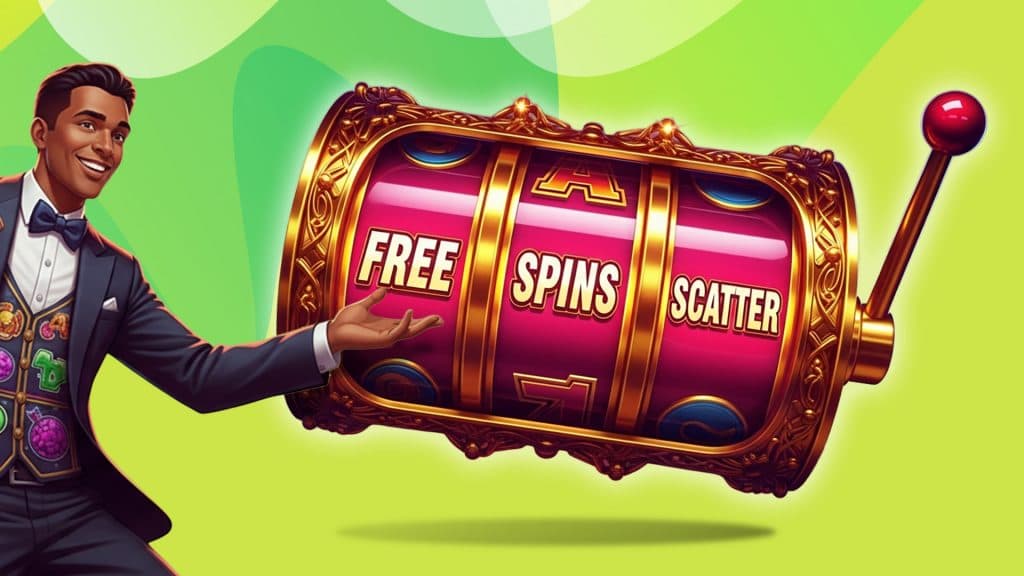
Bonus features are special mechanics that sit beyond the base-game spin. They can include free spins, wilds, scatters, multipliers, bonus picks, jackpots, expanding reels, and more.
Features matter because they often shape the slot’s personality. Some games are all about regular line wins. Others hold the real fireworks for the bonus round.
For more examples, see our guide to slot machine features explained.
Free Spins, Wilds and Scatter Symbols
Free spins are one of the most common slot bonus features. They usually trigger when enough scatter symbols land on the reels.
Wilds are symbols that substitute for other symbols to help form wins. Some wilds expand, move, stack, or carry multipliers.
Scatters often trigger features because they usually do not need to land on a specific payline. In many games, three or more scatters unlock free spins or a bonus round.
These symbols are easy to recognize once you know what they do. The paytable explains the exact rules.
Multipliers, Expanding Reels and Bonus Ladders
Multipliers increase the value of a win. A 2x multiplier doubles the payout. A 10x multiplier multiplies it by ten.
Some slots build multipliers across a bonus round. Others attach them to wild symbols, winning cascades, or special reel positions.
Expanding reels can add more rows or symbols during a feature, creating more possible ways to win. Bonus ladders may move players through prize levels, feature stages, or jackpot tiers.
This is where modern slots can add serious top-end potential. The base game may look simple, but the bonus mechanics can completely change the ceiling.
Pick-and-Click Bonuses and Second-Screen Features
Pick-and-click bonuses move the player to a separate bonus screen. You might choose from treasure chests, coins, cards, doors, or prize symbols.
These features are usually still controlled by the game’s math. The interaction adds suspense, but it does not mean the player has discovered a skill-based shortcut.
Second-screen bonuses can award instant prizes, multipliers, jackpot entries, or free spins. As always, the paytable explains what can happen and how the feature is triggered.
Why Some Slots Save More Value for the Bonus Round
Some slots put more of their payout potential inside bonus rounds. That can make the base game feel quiet while the feature carries the heavy machinery.
This often connects to volatility. If a slot’s biggest wins come from rare bonus chains, multipliers, or jackpot triggers, the game may have longer dry spells between major moments.
That does not make the feature “bad.” It means players should understand where the value sits before choosing the game.
How Do Progressive Slot Jackpots Work?
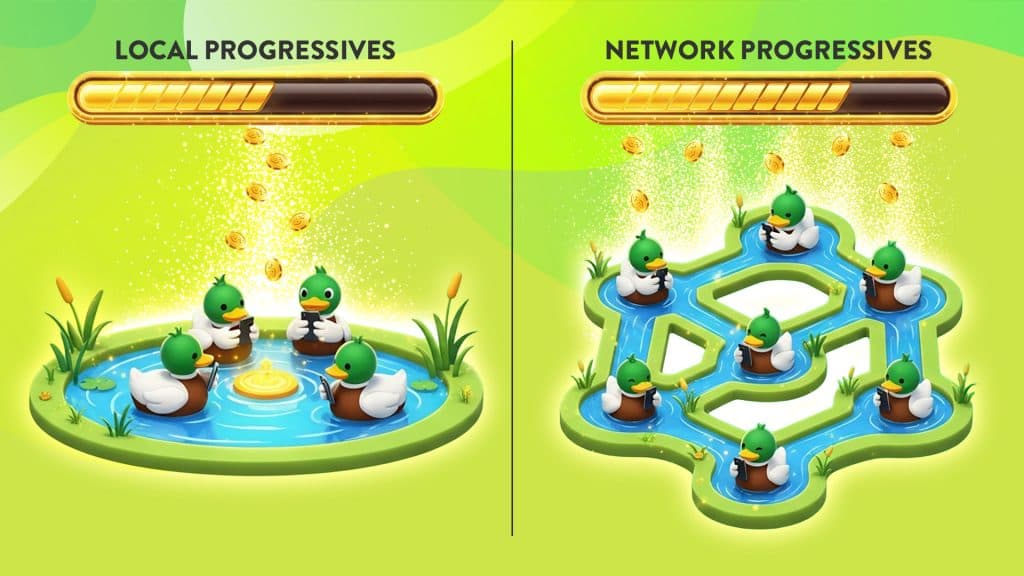
Progressive slot jackpots grow over time. A small portion of eligible bets may contribute to a jackpot pool until someone wins it.
That jackpot can be local to one game or connected across multiple games, casinos, or networks depending on how the slot is built.
For more jackpot-focused guidance, see our guide to types of jackpot slots.
Local vs Networked Progressive Jackpots
A local progressive jackpot is tied to one machine, one game, or one casino.
A networked progressive jackpot links multiple games or casinos into a shared prize pool. Because more bets feed the pool, networked jackpots can grow much larger.
| Jackpot Type | How It Works |
| Local progressive | Grows from play on a limited game or casino setup |
| Networked progressive | Grows from linked games across a wider network |
| Fixed jackpot | Has a set prize amount rather than a growing pool |
The bigger the network, the faster the jackpot may grow. The exact setup depends on the game provider and casino.
How Jackpot Pools Grow Over Time
Progressive jackpot pools grow when part of each eligible wager contributes to the prize pool.
For example, a small percentage of qualifying bets may go toward the top prize. The rest of the game still follows its own paytable and payout structure.
When the jackpot is won, the prize usually resets to a starting amount. Then the cycle begins again.
Why Progressive Slots Can Have Lower Base-Game Returns
Progressive slots may feel different because part of the overall prize structure can sit in the jackpot rather than regular base-game wins.
That can mean the base game feels less active than a non-progressive slot with similar visuals. The big prize is sitting at the top of the structure, not necessarily in frequent everyday line wins.
This is why progressive slots can feel more volatile. You are playing for a chance at a larger prize, but the path there may be bumpier.
For more on that choice, read about regular vs progressive slots.
When Max Bet May Matter for Jackpot Eligibility
Max bet matters only when the slot’s rules say it matters.
Some jackpot slots require a maximum bet, specific coin value, or side wager to qualify for the top prize. Others allow jackpot eligibility at different bet levels. There is no universal rule.
Before chasing a progressive jackpot, check the paytable and game rules. Look for eligibility requirements, prize tiers, and whether the jackpot is available at your chosen bet.
Types of Slot Machines and How They Work
Slot machines come in different styles, but they all use the same basic foundation: random outcomes, paytable rules, and payout math.
The difference is in how the game displays results and where the value is placed.
Classic Slots
Classic slots usually have three reels, simple symbols, and straightforward paylines.
They often use familiar icons like cherries, bars, bells, and sevens. The gameplay is simple, and the feature set is usually lighter than modern video slots.
Classic slots are easy to read because there are fewer moving parts. That can make them appealing when you want a clean, old-school format.
Video Slots
Video slots are the modern standard. They usually have five reels, richer graphics, animated features, free spins, wilds, scatters, and bonus rounds.
These games often have more complex paytables and more varied volatility. One video slot might be steady and feature-light. Another might be built around cascading wins, multipliers, expanding reels, and a giant max win.
Video slots are where most modern slot mechanics live.
Megaways Slots
Megaways slots use changing reel heights to create a different number of ways to win on each spin.
One spin might have hundreds of ways. Another might have thousands. The layout changes as the reels land, which creates a more unpredictable feel.
Megaways games are often volatile because they can produce big chain reactions, especially when paired with cascading wins and multipliers.
Penny Slots
Penny slots are named for low coin denominations, but that does not always mean the full spin costs one cent.
A penny slot may use many paylines, adjustable bet levels, or multiple coins per line. The total bet per spin can be much higher than the denomination suggests.
Always check the total wager before spinning. The “penny” label usually refers to the coin value, not necessarily the final cost of a spin.
Progressive Slots
Progressive slots include jackpots that grow over time.
They may be classic-style games, video slots, Megaways slots, or jackpot-focused titles with multiple prize tiers. What defines them is the growing prize pool.
Progressive slots can offer huge upside, but they often come with more volatility and specific eligibility rules.
Online Slots vs Casino Slot Machines: Do They Work Differently?
Online slots and casino floor slot machines share the same core idea: random outcomes, paytable rules, and long-term payout math.
So, how do casino slot machines work compared with online slots? The core mechanics are similar, but the display, regulation, game information, and player experience can differ by market and machine type.
How Online Slots Are Tested and Certified
Regulated online slots in licensed markets are typically tested according to market requirements before they are made available to players.
Testing can include RNG behavior, game math, payout accuracy, stated RTP, and whether the game follows its approved rules.
Players may see testing bodies such as GLI, BMM Testlabs, iTech Labs, or eCOGRA referenced in the wider iGaming industry. The exact testing body depends on the provider, market, regulator, and licensing setup.
How Casino Floor Slots Are Regulated
Casino floor slots are also regulated, but the rules depend on the jurisdiction.
In land-based casinos, machines must meet local gaming requirements. Regulators may review machine software, payout settings, approved game versions, and operational standards.
Players do not always see the same level of on-screen detail they get from online slots, but the machine still operates under a defined regulatory framework.
Where to Find RTP, Rules and Game Information Online
Online slots usually make game information easier to find.
Look for an info button, menu icon, question mark, or paytable section. That area may include:
- RTP
- Paylines or payways
- Symbol values
- Bonus rules
- Jackpot eligibility
- Bet limits
- Max win
- Feature explanations
If you are trying to understand how a slot works, the game info screen is the first place to look.
Are Slot Machines Fair?
Regulated slot machines are considered fair when they operate according to approved game math, certified RNG behavior, and the rules shown to players.
Fair does not mean favorable to the player on every spin. Slots still have a house edge. That edge is part of the design.
RNG Certification and Third-Party Testing
RNG certification checks whether the game produces random, independent outcomes according to its approved design.
Third-party testing labs may review the RNG, game math, RTP calculations, and payout behavior before a slot is released in regulated markets.
This does not mean the player can beat the game. It means the game should operate according to its rules.
Licensing, Regulators and Compliance Checks
Licensing and regulation help set standards for how online casino games are offered.
A regulated casino should make key game information available and use approved software from recognized providers. Requirements vary by market, but the purpose is similar: make sure the games operate as approved.
Players should use licensed platforms and check game rules before playing.
How to Check a Slot’s Rules Before Playing
The fastest way to check a slot’s rules is to open the paytable or game info screen.
Look for:
| What to Check | Why It Matters |
| RTP | Shows long-term theoretical return |
| Volatility | Helps set expectations for session swings |
| Paylines/payways | Explains how wins are formed |
| Bonus triggers | Shows how features unlock |
| Max win | Shows top-end payout potential |
| Jackpot rules | Confirms eligibility requirements |
| Bet range | Helps match the game to your budget |
Check this before you spin. The paytable is a lot more useful before the reels start moving than after the session has already taken a turn.
How to Choose a Slot Based on How It Works
Once you understand how slot machines work, choosing a game becomes less about guesswork and more about fit.
The goal is not to find a machine that is “ready.” The goal is to choose a slot with math, features, and pacing that match the session you want.
For a deeper selection guide, read how to choose the right slot game. You can also use our practical checklist on how to pick a slot machine if you want to compare games before playing.
Choose RTP Based on Session Length
Higher RTP can be useful for longer sessions because the game’s long-term return is stronger.
That does not guarantee a better result today. A higher RTP slot can still run cold. A lower RTP slot can still hit a strong bonus.
Use RTP as one filter, not the full decision.
Match Volatility to Your Bankroll
Volatility should match the bankroll you bring to the session.
If the game is highly volatile and your budget only covers a short run of spins, you may not give the slot much room to show its feature cycle. If the game is lower volatility, the session may feel steadier, but the top-end potential might be smaller.
A simple rule: if the slot is highly volatile, your bet size should leave room for dry spells.
For more practical budget planning, see our guide to slots bankroll management.
Pick Bonus Features That Fit Your Play Style
Bonus features shape the experience.
If you like steady action, look for games with frequent small features, wilds, and simple free spins. If you want bigger swings, look for multipliers, retriggers, expanding reels, jackpots, or feature ladders.
The right bonus is not always the biggest one. It is the one that fits how you want the session to feel.
Top Tip: The studio behind the game can also provide an early clue about the mechanics and presentation you can expect. Our guide to the best online slots providers compares the defining styles of the leading developers at SlotsLV.
Check Jackpot Rules Before You Bet
Jackpot rules deserve their own look.
Before playing a progressive slot, check whether the jackpot requires a max bet, side bet, specific coin value, or minimum stake. If you are not eligible for the top prize, you should know that before you start.
The paytable is the best place to confirm eligibility before you commit to a jackpot slot.
Common Slot Machine Myths
Slot myths stick around because slot machines are random and randomness feels strange. Players naturally look for signs, timing, patterns, and clues.
Most of those clues are noise.
For more myth-busting, read our guide to common slot machine myths.
Can You Tell When a Slot Machine Will Hit?
No. You cannot tell when a slot machine will hit.
A long dry spell does not mean a bonus is coming. A recent big win does not mean the game is finished paying. Each spin is independent, and the RNG decides the result.
You can spot a high-volatility game. You can read the paytable. You can understand the max win. But you cannot see the next result coming.
Does Stopping the Reels Change the Outcome?
No. Stopping the reels early does not change the outcome on a standard online slot.
The result has already been selected by the RNG. The reel stop button only speeds up the animation.
It may feel like you are taking control, but the math has already done its work.
Are Hot and Cold Slot Machines Real?
Not in the predictive sense.
A slot can appear hot if it has recently paid several wins. It can appear cold if it has gone quiet. But those labels describe what already happened, not what is about to happen.
The next spin is not influenced by the last few results. “Hot” and “cold” describe past outcomes, not what the RNG is about to do.
Is There a Trick to Slot Machines?
There is no trick that lets you predict or beat slot machines.
The useful edge is understanding the mechanics, not trying to outguess them. Read the paytable. Know the RTP. Check volatility. Understand jackpot eligibility. Match the game to your bankroll and session goal.
That will not change the RNG. It will change how prepared you are.
More About How Online Slots Work
How do online slots decide who wins?
Online slots decide each spin using a random number generator. The RNG selects a result, the reels display that result, and the paytable determines whether it pays. Each spin is independent from the one before it.
How do online slot machines pay out?
Online slot machines pay out when the result matches a winning combination in the paytable. The payout depends on the symbol combination, the game rules, and your bet size. Bonus features and jackpots may have separate payout rules.
Can you actually win money with online slots?
Yes, you can win money with online slots, but wins are random and never guaranteed. Slots are built with a house edge, so the long-term math favors the casino even though individual players can hit winning sessions.
Are slots all luck or is there skill?
Slots are mostly luck because the RNG decides each result. The skill is not in controlling the outcome. It is in choosing games wisely, understanding RTP and volatility, checking rules, and managing your session expectations.
How do I pick a winning slot machine?
You cannot pick a guaranteed winning slot machine. What you can do is choose a better-fit slot by checking RTP, volatility, bonus features, max win, paylines, and jackpot rules before you play.
What is the $20 method in slots?
The $20 method is a budgeting approach where a player limits a session, machine, or bet sequence to $20. It does not improve the odds or help predict wins. It is a bankroll-control method, not a slot strategy that beats the RNG.
What is the $100 slot method?
The $100 slot method is another session-budget idea where a player sets aside $100 and decides how to divide it across spins or machines. Like the $20 method, it does not change the odds. It only controls how much you risk.
Do slot machines pay more at certain times?
No. Slot machines do not pay more at certain times in a way players can reliably use. Regulated slots follow their programmed math and RNG outcomes. A machine does not become more likely to pay because of the time of day.
What It’s Important to Understand About How Slots Work
Slot machines work through random outcomes, fixed paytable rules, and long-term math. The RNG decides each spin, the paytable defines payouts, RTP shows the theoretical return, and volatility shapes how wins are distributed.
You cannot predict the next spin. But you can understand the machine better. That means reading the rules, checking the RTP, knowing the volatility, understanding the bonus structure, and choosing slots that fit the kind of session you actually want.