
Fibonacci Slot Strategy: Natural Balance for Your Bankroll
The Fibonacci sequence appears in sunflower heads, where the seeds form tidy spirals, in pinecones stacked with perfect symmetry, and in seashells that curl outward in a smooth, natural arc.
As it turns out, it appears in slot games, too.
The Fibonacci slots strategy sequence gradually increases bets, while taking protective steps backward after losses.
Many players hail the Fibonacci slot betting system as one of the safest progression systems, but does it unfold as gracefully in practice? Let’s find out.
What is the Fibonacci Betting System for Slots?
In the Fibonacci slots sequence, each number comes from adding the two before it: 1, 1, 2, 3, 5, 8, 13, and continues onward.
As a slots betting system, each number represents a betting unit. You move forward one step after each loss, allowing your bets to build gradually.
If you win, you step back two numbers, easing the pressure and restoring balance.
This approach contains bets within a manageable range while slowly increasing gains and gently recovering losses.
How to Use Fibonacci in Slot Betting
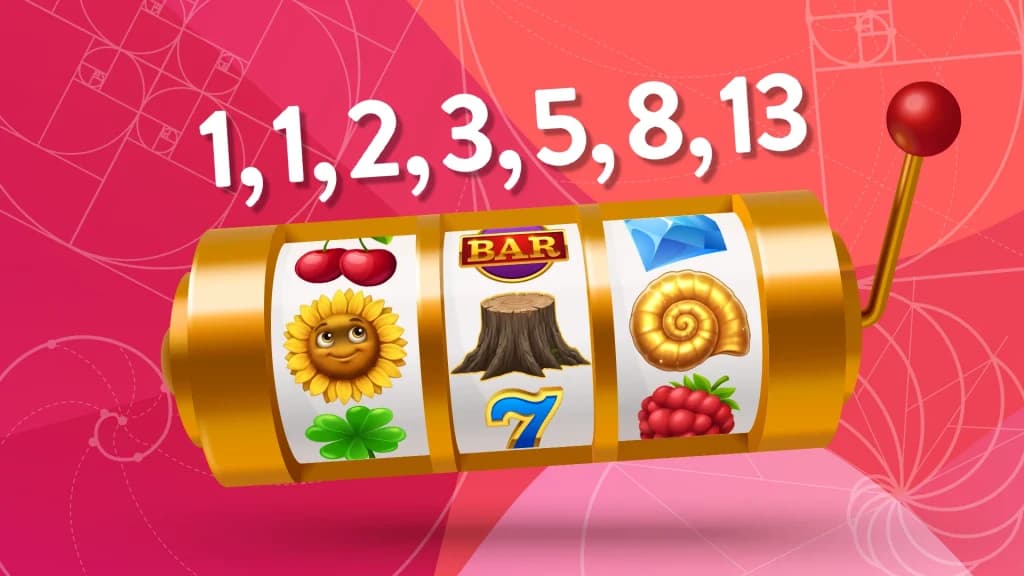
To use the Fibonacci betting system on slots, start with the first number of the sequence, which, conveniently, is “1.”
Bet one unit on your first spin.
If you lose, move forward one number in the sequence.
If you lose again, move forward one more.
Continue moving forward one number each time you lose, betting that number of units for your next spin.
If a winning spin lands, retreat two numbers in the sequence to ease the pressure.
Example: Fibonacci Strategy in Real Slot Session
In a real slot game, let’s begin by picking a base unit. We’ll go with $1 for this example.
This is your smallest step, like the first tight scale at the center of a pinecone. Remember, the sequence is:
1, 1, 2, 3, 5, 8, 13, 21, 34…
- You bet $1 unit on your first spin.
- You lose, so you move forward one step to the number 1. This means you bet $1 yet again.
- It’s another losing spin, so you shrug your shoulders and bet $2.
- On your next spin, you lose again. You’re on a bad run, but it’s all good. Just bet $3 and try again.
- Look at that, a win! Now, to protect your win, drop back two steps. That puts us back at $1 (the second $1).
- You win the next round, so you go back to the very beginning at $1.
- Then you begin again.
Ideal Slot Machines for the Fibonacci Betting System
Fibonacci works best in slots with low to medium volatility, since the long, brutal losing streaks of higher-volatility slots can push the sequence higher than you’d like.
Bankroll Management
From a bankroll perspective, approach the Fibonacci sequence with moderation.
You don’t need a Jupiter-sized balance, but you do need enough soil-like cushion to survive a few steps forward in the sequence before you can grow.
Fibonacci Doesn’t Change the Odds
Regardless of your bankroll size or slot type, remember that the Fibonacci gambling strategy does not change the odds or overcome the RNG (random number generator) that determines wins in slots.
Outcomes are still, and always will be, entirely random. The Fibonacci strategy simply gives you a structure to manage them.
Pros and Cons of the Fibonacci Slots System

Like everything that grows in nature, Fibonacci slots system has its strengths and its limits.
The same gentle pattern that creates balance and symmetry, like oak tree rings, also comes with boundaries, like the width of its trunk.
Pros
- Gradual, controlled bet increases
- Protective step-backs after wins, helping stabilize your bankroll
- Less aggressive than Martingale, with smaller jumps between bets
- Clear structure that removes emotional decision-making
- Well-suited to steady, medium-risk sessions
Cons
- Slots have a limited betting range, which prevents you from climbing higher in the sequence and recovering losses
- Bet sizing friction, because most slots use preset denominations instead of allowing exact custom bets
- Slower recovery, as it takes more wins to offset losses compared to aggressive systems
- No impact on odds, since RNG outcomes remain completely random
Fibonacci vs Other Slots Systems

All slot betting systems try to bring order to randomness, but they do it in very different ways.
Fibonacci vs. Martingale
The key difference between the Fibonacci and the Martingale is how quickly risk escalates.
Martingale doubles your bet after every loss. Your bets jolt upward like the runaway elevator from Willy Wonka. If you start with a dollar, your wager jumps to $128 after just seven losses, and that’s not unheard of in slots. Doubling after each loss is intense, like the logarithmic swirl of a hurricane, another famous Fibonacci sequence in nature, and that’s not what we want to see in slots.
The Fibonacci system mitigates this risk by increasing bets more gently. That slower climb makes this method far less punishing during losing streaks, though it also means losses take longer to recover.
Fibonacci vs. the 1-3-2-6 System
For starters, the Fibonacci betting system increases bets after losses, whereas the 1-3-2-6 only increases after wins.
The Fibonacci strategy could theoretically continue forever, as there is no natural end to the sequence. The problem is that without a clear end, your bankroll could spiral on a losing streak, and we don’t mean spiraling in a lovely way, as it does with a sunflower.
The 1-3-2-6 betting strategy is a sequence that only has four numbers. This natural stopping point helps protect your bankroll.
Ready to try Fibonacci on Slot Machines?
Where other slot betting systems race, the Fibonacci betting strategy glides with grace.
Pick a slot with a large built-in betting range and lower volatility. Then, start with one unit, make like a seashell, and ride the tide.