

What Is RTP in Slots? How Return to Player Works
RTP in slots stands for Return to Player.
It’s the percentage of all money wagered on a slot that the game is designed to pay back over an enormous number of spins.
Take a slot with 96% RTP. It’s designed to pay back $96 on average for every $100 wagered over the long run.
That $100 includes any winnings you bet again. Your own session could return a lot more or less than $96.
In this guide, you’ll learn more about what RTP means in slots, the math behind the figure, the RTP benchmarks to look for, where to find the percentage in a slot game, and how RTP works with the slot’s volatility.
Summary
- RTP is the percentage of total wagers a slot is designed to pay back over time.
- The advertised RTP is a long-run expectation. Your session results can vary widely.
- An RTP of 96% is a common benchmark for online slots.
- RTP tells you how much a slot pays back over time. Volatility tells you how widely payouts can vary from spin to spin.
Jump to
- What Does RTP Mean in Slots?
- How Is Slot RTP Calculated?
- RTP vs. House Edge: What’s the Difference?
- What Is a Good RTP for Slots?
- How to Find a Slot’s RTP
- RTP vs. Volatility: Why Two 96% Slots Play Differently
- How to Use RTP When Choosing a Slot
- Bottom Line
- FAQs
What Does RTP Mean in Slots?
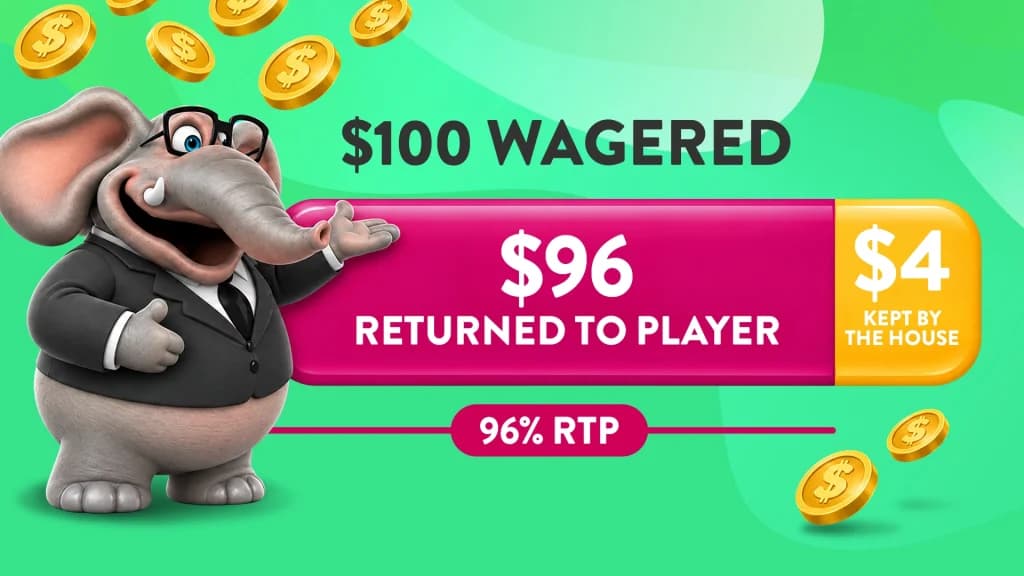
Return to Player (RTP) is the percentage a slot is designed to pay back over the long run. The game developer calculates it from the possible payouts and how likely each one is.
If we look at a 96% RTP, that means the slot would theoretically return $96 out of $100 wagered, and keep $4.
To work out your actual return, divide your total payouts by your total wagers and turn it into a percentage. If you wager $100 and get $20 back, your return is 20%. Get $150 back and it’s 150%. Both can happen on the same 96% slot.
You might also see “player percentage” in a game’s paytable or info screen. RTP and payout percentage mean the same thing in slots.
How Is Slot RTP Calculated?
To calculate RTP, game developers multiply each possible payout by the chance it happens.
They add those amounts together to get the average payout per spin, then divide by the cost of the spin and convert the result to a percentage.
Math Behind RTP
Imagine a simplified slot that costs $1 per spin. It pays $2 on 40% of spins, $4 on 4% of spins, and $0 on the remaining 56%.
The $2 payout contributes 80 cents to the average return ($2 X 40%). The $4 payout adds another 16 cents ($4 X 4%). Spins that pay nothing add zero. Put those together, and you get an average payout of 96 cents per $1 wagered, or 96% RTP.
Why Your Session Won’t Match the RTP
Each spin is driven by the slot’s RNG (random number generator). What you get back depends on the outcomes that land during your session.
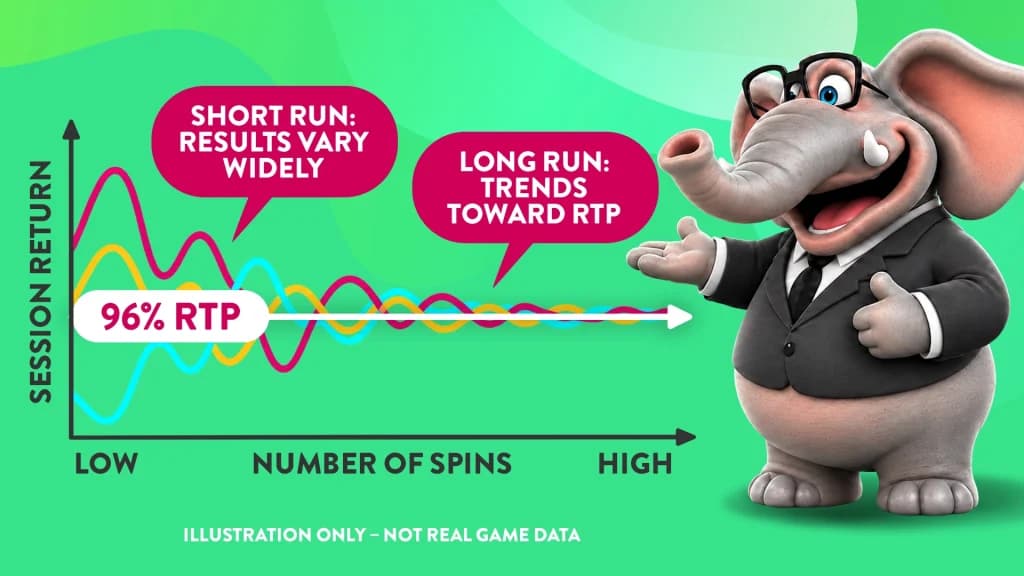
In a smaller sample size, such as 20 spins, one big payout can push your return well above the stated RTP, while a dry spell can leave you far below it.
Across a very large number of spins, the share of wagers paid back tends to get closer to the stated RTP. A run of spins can still finish above or below that figure.
Who Sets and Tests RTP
The developer sets the RTP in the game’s math, and independent testing labs can check it. Some slots come in versions with different RTPs. Check the rules in the version you’re playing for the figure that applies.
RTP vs. House Edge: What’s the Difference?
For a slot, the house edge is 100% minus the RTP. If a slot’s RTP is 96%, the house edge is 4%.
Let’s see an example.
Say you bet $1 per spin for 200 spins. You’ve bet a total of $200. To work out what the house edge will cost you on average, multiply your bet size by the number of spins and the house edge ($1 X 200 X 4% = $8). That’s an $8 average loss per $200.
That $8 is the expected cost of wagering $200 at a 4% house edge. A single session could end ahead, or you could lose considerably more.
For the same amount wagered, a lower house edge means a lower expected cost over time.
What Is a Good RTP for Slots?
Around 96% is a common benchmark for online slots, and 97% or above is usually considered high. For examples, see our guide to the highest RTP slots.
| RTP range | House edge | Expected return per $100 wagered | What it means for players |
| 97% and above | 3% or less | $97 or more | High RTP. The game keeps $3 or less per $100 wagered on average. |
| 96% to 96.99% | 3.01% to 4% | $96 to $96.99 | A solid, average benchmark |
| 94% to 95.99% | 4.01% to 6% | $94 to $95.99 | Below the 96% benchmark. The game keeps about $4 to $6 per $100 wagered on average. |
| Below 94% | More than 6% | Less than $94 | Low RTP. The game keeps more than $6 per $100 wagered on average. |
For a progressive slot, check what the published figure covers. The game may show one RTP that includes the jackpot, or list the base-game and jackpot portions separately.
If you’re playing slots online, you’ll find the RTP in the game’s info screen or paytable. On the other hand, land-based slot machines don’t usually publish their games’ RTPs. Our guide on online vs casino slots payouts explains this difference in more detail.
How to Find a Slot’s RTP
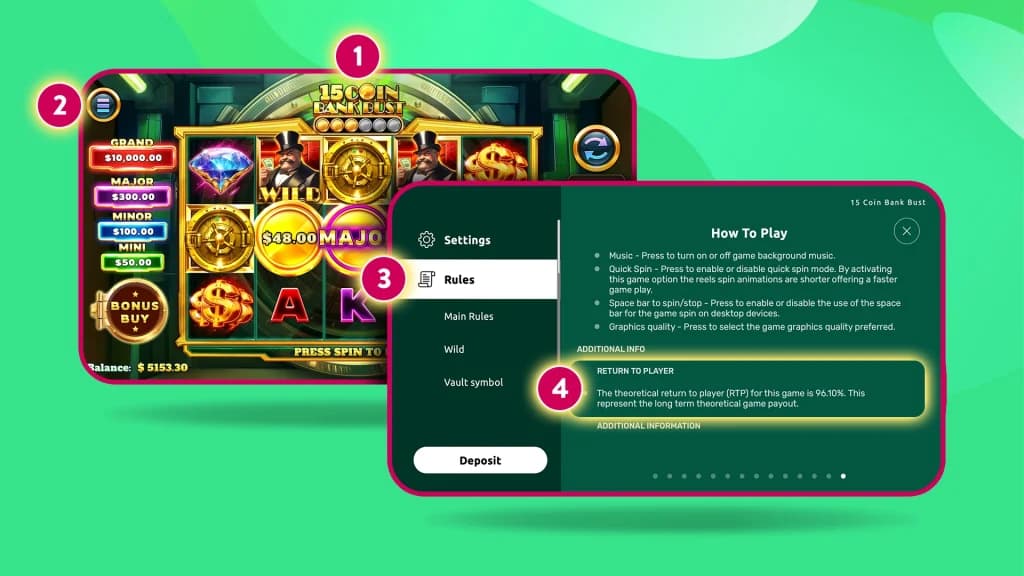
In most online slots, you’ll find the RTP in the game’s paytable, info, or rules screen. Land casinos are a different story, and they rarely post the RTP for their slot machines.
Follow the steps below to find an online slot’s RTP.
- Open the game.
- Open the info or paytable menu. Look for the ‘i’, question mark ‘?’, or hamburger icon (three horizontal lines).
- Find the rules or game information page. You might have to scroll through the paytable a bit to find it.
- Read the stated RTP. The RTP will be listed as a percentage (96%) or stated as “average return”, “theoretical return,” or something similar.
For more help decoding the info panel, check out our guide on how to read a slot paytable.
If you play the same game at different casinos, you might see that the RTP for the same title is slightly different. That’s because some games are configured with more than one RTP setting. When in doubt, trust the stated RTP figure in the paytable of the game you’re currently playing.
RTP vs. Volatility: Why Two 96% Slots Play Differently
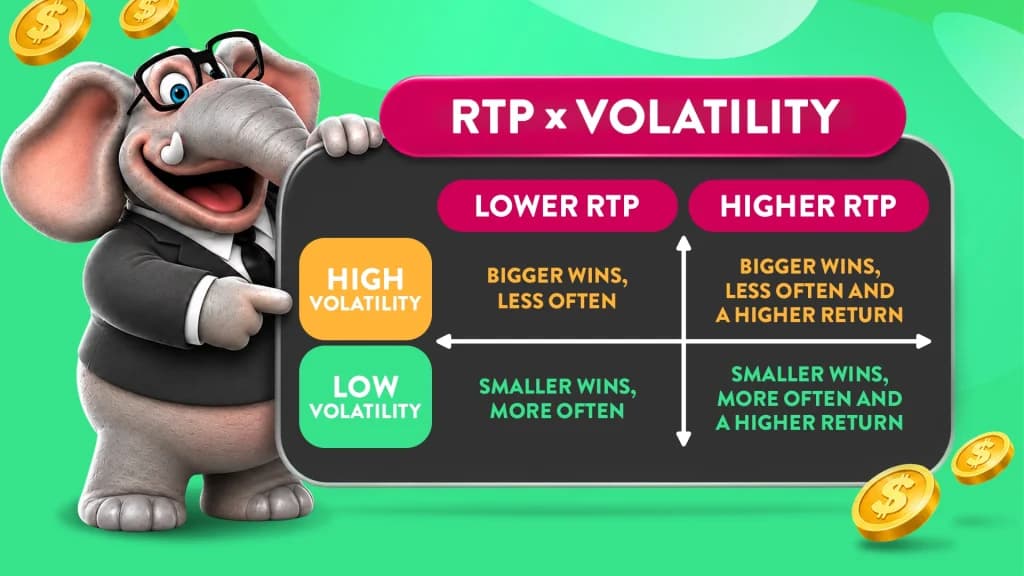
Two slots can both have a 96% RTP and still feel completely different. One might pay out smaller amounts more regularly. The other might have longer gaps between payouts and some larger prizes.
What Volatility Measures
Volatility describes how widely a slot’s payouts can vary.
Low-volatility slots tend to have smaller swings.
Medium-volatility slots sit in the middle.
High-volatility slots can have longer gaps between meaningful payouts and bigger swings when they land.
For a deeper dive, check out our guide: What is slot volatility?
| Low volatility | Medium volatility | High volatility | |
| Payout pattern | Often steadier | Some swings | Can have longer gaps |
| Typical win size | Smaller | A mix of small and large | Larger |
| Bankroll swings | Smaller ups and downs | Moderate ups and downs | Deeper drops and taller jumps |
| SlotsLV example | Burning Cash | Winning Vegas | Golden Buffalo |
| What it can feel like | Smaller changes from spin to spin | A mix of quieter stretches and bigger swings | Longer quiet stretches with occasional bigger changes |
Hit Frequency Explained
A slot’s hit frequency means how often a spin returns a win. Although they all contribute to a slot’s framework, paylines and hit frequency are not the same as RTP or volatility.
Hit frequency tells you how often a spin pays anything, even if the payout is smaller than the bet. Volatility describes how widely results can swing.
How Jackpots and Bonus Features Affect RTP
Some slots, such as A Night With Cleo, have a progressive jackpot. When part of the expected return comes from a rare jackpot or bonus, that part shows up only when the feature pays. The base game can feel quieter in between.
How to Use RTP When Choosing a Slot
RTP is a valuable metric to have, but it’s just one filter when choosing a slot. RTP works alongside volatility, features, and your own personal taste. RTP alone doesn’t define a slot, nor does it predict the outcome of the spins.
Here’s what to check in a slot’s rules before you play.
- Check the RTP. Compare the stated figures for the versions you’re looking at.
- Check the volatility. It gives you an idea of how widely your results can swing.
- Match the volatility to your session budget and length. Choose a volatility that works with the size of your bankroll and how long you expect your session to be.
- Check what the RTP includes. If the rules list a jackpot share separately, you can see how much of the expected return comes from the base game.
If you use the SlotsLV Welcome Bonus, check which games qualify and how their wagers count toward the requirements. Our guide shows you how to use your welcome bonus.
No matter which slot you play, responsible gaming is always a priority. Only wager what you can afford to lose, and establish a clear stopping point before you play.
RTP in Slots: The Bottom Line
RTP tells you what share of total wagers a slot is designed to pay back over the long run. Your own session can finish far above or below that figure.
Check volatility for an idea of how widely results can swing and hit frequency for how often a spin pays anything.
Now, as you explore our collection of slot games at SlotsLV Casino, you have a clear idea of what you’re looking for before you spin.
More About RTP in Slots
Is 96% a good RTP for a slot?
Yes. A 96% RTP is a common benchmark and implies a 4% house edge. Over the long run, that works out to $4 in expected losses for every $100 wagered. See the benchmark table above to compare other RTP ranges.
Does a higher RTP mean I’ll win more often?
A higher RTP means a higher expected return over the long run. To see how often a game pays anything on a spin, check its hit frequency if the game publishes it. A paying spin can return less than your stake.
Can a slot’s RTP change while I’m playing?
The stated RTP applies to the version you’re playing. Your session length, the time of day, and earlier wins or losses do not change it. Another version of the same title may have a different RTP, so check the current game’s rules.
Why does the same slot show different RTPs at different casinos?
Game developers sometimes offer the same slot with several RTP settings, so two casinos can run versions with different payout percentages. Trust the RTP listed in your current game’s paytable, as that’s the accurate figure for the specific game in front of you.
Do jackpot slots have lower RTP?
A progressive slot can devote some of its expected return to the jackpot. The stated RTP may already include that share, or the rules may show it separately from the base-game RTP. Check the paytable to see which figure applies.
Do online slots have higher RTP than slot machines in casinos?
RTP varies by game and version. Online slots commonly show the figure in their rules or paytable, while land-based machines may disclose less. If the percentage is available, compare the figures for the specific games you’re looking at.
Is RTP the same as payout percentage?
Yes. In a slot’s paytable, payout percentage is another name for RTP. Both describe the share of total wagers the game is designed to return over the long run. The amount you get back in a session can differ widely.